As a seasoned supplier of twin – screw extruders, I understand the pivotal role that screw configuration plays in determining the success of the extrusion process for different materials. In this blog, I will share some valuable insights on how to optimize the screw configuration for various materials in a twin – screw extruder. Twin-screw Extruder
Understanding the Basics of Screw Configuration
The twin – screw extruder is a versatile machine that consists of two intermeshing screws rotating within a barrel. The screws are divided into different sections, each with a specific function such as feeding, melting, mixing, venting, and pumping. The screw configuration is mainly defined by elements like screw pitch, flight depth, element length, and the arrangement of different screw elements (e.g., conveying elements, kneading blocks, and reverse – flight elements).
The choice of screw configuration has a significant impact on parameters such as output rate, melt quality, degree of mixing, and energy consumption. For different materials, these requirements vary greatly. For instance, polymers with high viscosity may need more intense mixing, while some heat – sensitive materials require a gentle processing environment to avoid degradation.
Optimizing for Polyolefins
Polyolefins, such as polyethylene (PE) and polypropylene (PP), are among the most commonly used polymers in the industry. These materials are relatively easy to process, but to achieve high – quality products, proper screw configuration optimization is still necessary.
- Feeding Section: Polyolefins are usually in the form of pellets or powders. A large – pitch conveying element with a deep flight depth is often used in the feeding section to quickly and efficiently transport the materials into the extruder. This helps to ensure a stable feed rate.
- Melting Section: In the melting section, kneading blocks are introduced to generate shear heat, which aids in melting the polyolefin pellets. The kneading blocks are typically arranged in a staggered pattern to promote better mixing and heat transfer. For polyolefins with higher molecular weights, more kneading blocks may be needed to ensure complete melting.
- Mixing and Homogenization: After melting, the material needs to be well – mixed to achieve a uniform melt. Conveying elements with appropriate pitch and flight depth can be combined with kneading blocks to ensure that additives, such as antioxidants or colorants, are evenly dispersed in the polyolefin matrix.
Tailoring for Engineering Plastics
Engineering plastics, like polyamide (PA), polycarbonate (PC), and polyetheretherketone (PEEK), have higher performance requirements and are more challenging to process than polyolefins.
- High – Shear Mixing: Engineering plastics often require intense mixing to disperse fillers or additives and to improve the compatibility between different polymer components. Steeper – angle kneading blocks and reverse – flight elements can be used to generate high shear forces. However, excessive shear can also lead to polymer degradation, so careful control is needed.
- Temperature Control: These materials are also more sensitive to temperature fluctuations. The screw configuration should be designed to ensure that the heat generated during processing is evenly distributed. For example, using a combination of conveying and kneading elements with different geometries can help to control the residence time of the material in high – shear zones, thus preventing overheating.
- Venting: Many engineering plastics absorb moisture, which can cause defects in the final product. Therefore, a well – designed venting section with appropriate screw elements for air removal is crucial. Conveying elements with a reduced pitch can be placed before the vent to allow for pressure reduction and easy venting of moisture and volatiles.
Adapting to Biodegradable Polymers
Biodegradable polymers, such as polylactic acid (PLA) and polyhydroxyalkanoates (PHA), have gained increasing attention due to environmental concerns. However, they are generally more heat – sensitive compared to traditional polymers.
- Gentle Processing: To avoid thermal degradation, the screw configuration should be designed for gentle processing. A lower shear screw design with fewer kneading blocks and more conveying elements can be used. The screw pitch and flight depth should be adjusted to reduce the shear stress on the material, while still ensuring sufficient melting and mixing.
- Short Residence Time: Biodegradable polymers are also more prone to hydrolysis and oxidation during processing. Minimizing the residence time of the material in the extruder is essential. This can be achieved by optimizing the length – to – diameter ratio of the screw and using a more efficient conveying design.
Tweaking for Composite Materials
Composite materials, which consist of a polymer matrix and reinforcing fillers (such as glass fibers, carbon fibers, or mineral fillers), require special attention in terms of screw configuration.
- Filler Dispersion: The main challenge in processing composites is to ensure uniform dispersion of the fillers in the polymer matrix. Special mixing elements, such as toothed discs or high – intensity mixing kneading blocks, can be used to break up filler agglomerates and disperse them evenly.
- Fiber Length Preservation: For fiber – reinforced composites, it is important to preserve the fiber length during processing. A screw configuration with reduced shear in the fiber – feeding zone and proper metering and conveying sections can help to minimize fiber breakage. Reverse – flight elements can be used sparingly, as they tend to increase the shear force on the fibers.
Practical Tips for Screw Configuration Optimization
- Conduct Trials: Before implementing a full – scale production, it is advisable to conduct small – scale trials with different screw configurations. This allows you to evaluate the performance of the extruder and make necessary adjustments based on the properties of the final product.
- Monitor Process Parameters: Continuously monitor process parameters such as temperature, pressure, torque, and output rate during the extrusion process. These parameters can provide valuable feedback on the effectiveness of the screw configuration and help you identify any potential issues.
- Seek Expert Advice: If you are unsure about the optimal screw configuration for a particular material, do not hesitate to seek advice from experts in the field. As a twin – screw extruder supplier, we have a wealth of experience and technical knowledge to assist you in making the right decisions.
Conclusion
Optimizing the screw configuration for different materials in a twin – screw extruder is a complex but essential task. By understanding the properties of the materials and the functions of different screw elements, you can design a screw configuration that meets the specific requirements of your extrusion process. Whether you are processing polyolefins, engineering plastics, biodegradable polymers, or composite materials, the right screw configuration can significantly improve the quality of your products and the efficiency of your production.
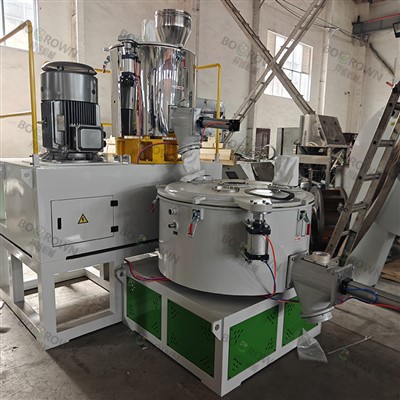
High Speed Mixer If you are interested in learning more about optimizing screw configurations for your twin – screw extruder or are considering purchasing a twin – screw extruder for your specific application, I encourage you to get in touch with us. We are dedicated to providing you with the best solutions and support to ensure the success of your extrusion operations.
References
- K. W. Potter, "Handbook of Polymer Extrusion Technology", William Andrew Publishing, 2nd Edition
- J. L. White and K. P. Bhattacharya, "Polymer Processing", Hanser Publishers, 1998
- S. Fakirov, "Plasticizer – Free Plasticization: Microstructure and Rheology of Amorphous Polymers", Wiley – VCH, 2002
ZJG BC Machinery Co., Ltd.
As one of the most professional twin-screw extruder manufacturers and suppliers in China, we’re featured by quality products and good price. Please rest assured to buy cost-efficient twin-screw extruder for sale here from our factory. Contact us for custom service and OEM service.
Address: No.8 Lexi Road, Leyu Town, Zhangjiagang City
E-mail: sales@bcextruder.com
WebSite: https://www.bcextruder.com/
